Tyceratops: A New Species of Ceratopsian Dinosaur
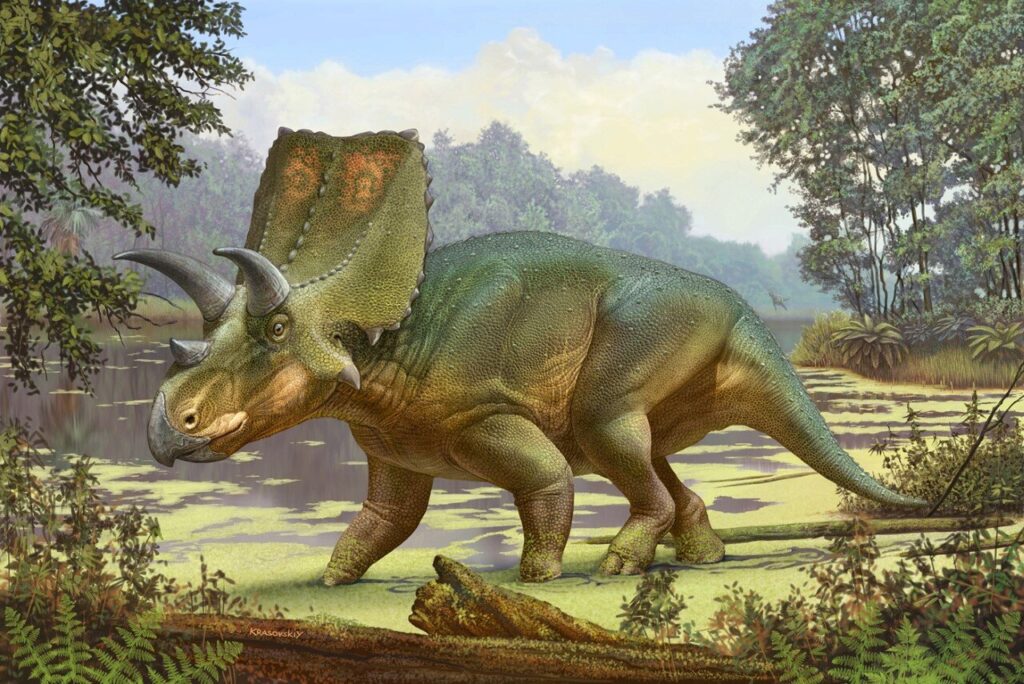
Ceratopsian dinosaurs, or “horned dinosaurs,” were a diverse group of herbivorous dinosaurs that lived during the Late Cretaceous period, about 100 to 66 million years ago. They are well-known for their characteristic skull ornamentation, which included various types of horns and frills. Recently, a new species of ceratopsian dinosaur was discovered in Montana, USA, and it has been named Tyceratops.
Discovery of Tyceratops
The fossils of Tyceratops were discovered in the Two Medicine Formation, a geological formation that is known for its abundance of Late Cretaceous fossils. The fossils were first uncovered by a group of amateur paleontologists in 2011, and were later excavated by a team of scientists from the Judith River Dinosaur Institute and the University of Washington. The fossils consisted of several skull fragments, including parts of the frill and the horns, as well as a few postcranial bones. Based on these fossils, the scientists were able to identify Tyceratops as a new species of ceratopsian dinosaur.
Description of Tyceratops
Tyceratops is believed to have lived during the Late Campanian stage of the Late Cretaceous period, about 76 to 73 million years ago. It was a relatively small ceratopsian, measuring about 2 meters (6.6 feet) in length and weighing about 100 kilograms (220 pounds). Like other ceratopsian dinosaurs, Tyceratops had a large, bony frill on the back of its skull. The frill was triangular in shape and had a rough, textured surface. It was adorned with two large, curved horns that projected backwards from the top of the frill. Additionally, Tyceratops had a smaller, powerful creature conical horn on its snout. The frill and horns of Tyceratops are distinctive in their shape and size, which sets this dinosaur apart from other ceratopsians. The scientists who described Tyceratops noted that the shape of the horns is reminiscent of the Greek letter omega (Ω), which inspired the dinosaur’s name (Tyceratops means “omega horned face”).
Implications of Tyceratops
The discovery of Tyceratops is significant because it adds to our understanding of the diversity of ceratopsian dinosaurs during the Late Cretaceous period. Prior to the discovery of Tyceratops, it was thought that there were only two types of ceratopsians living in the region where the fossils were found: the long-frilled Chasmosaurus and the short-frilled Rubeosaurus. Tyceratops appears to be an intermediate form between these two types, with a frill that is shorter than that of Chasmosaurus but longer than that of Rubeosaurus. This suggests that there was more variation in frill size and shape among ceratopsian dinosaurs than previously thought. Furthermore, the discovery of Tyceratops highlights the importance of amateur paleontologists in the discovery of new dinosaur species. The initial discovery of the fossils was made by a group enthusiasts and dinosaur of amateur paleontologists who were exploring the Two Medicine Formation. Without their efforts, the fossils of Tyceratops may have gone undiscovered.
Conclusion
Tyceratops is a new species of ceratopsian dinosaur that was recently discovered in Montana, USA. It is an important addition to our understanding of the diversity of ceratopsian dinosaurs during the Late Cretaceous period. Its distinctive frill and horns suggest that there was more.